

Treatment of cysts and benign ovarian diseases
Cysts and benign ovarian growths can cause abdominal pain, menstrual irregularities and problems with conception.

Among all ovarian tumors, benign tumors account for about 80%. Specialists from Olympus Clinics will help diagnose and cure diseases in a timely manner.
Benefits
Preservation of reproductive functions
Careful selection of the surgery method allows you to preserve the reproductive organs.
Accuracy and safety
Modern surgical techniques make it possible to remove benign formations as accurately as possible.
The possibility of histological analysis
The resulting tissues are analyzed, which eliminates the risk of malignant changes.
Prevention of the development of malignant neoplasms
Timely elimination of benign formations reduces the risk of their degeneration into malignant ones.
Preparation for the treatment of cysts and benign ovarian diseases
Diagnosis includes ultrasound of the pelvic organs, as well as, if necessary, MRI, laparoscopy to assess the size, structure and location of the formations. The patient may be prescribed blood tests, including cancer markers, to assess the risk of malignant degeneration. Based on the results obtained, the doctor determines the treatment tactics.

Treatment of cysts and benign ovarian diseases
The choice of treatment method depends on the patient's age, her reproductive plans, the presence of other diseases, as well as educational characteristics. With oophorectomy, the affected ovary is removed, with adnexectomy, the ovary is removed along with the fallopian tube. There is also a wedge—shaped ovarian resection, a gentle method used mainly in women of reproductive age. During this operation, only the part of the ovary containing the tumor is removed.

Recommendations after treatment of cysts and benign ovarian diseases
After surgery, it is important to follow all the doctor's recommendations, including taking prescribed medications, limiting physical activity and regular examinations to monitor your health. This will help speed up the recovery process and reduce the risk of possible complications. Pregnancy can be planned no earlier than six months after the intervention.

Врачи
Смотреть всех врачей
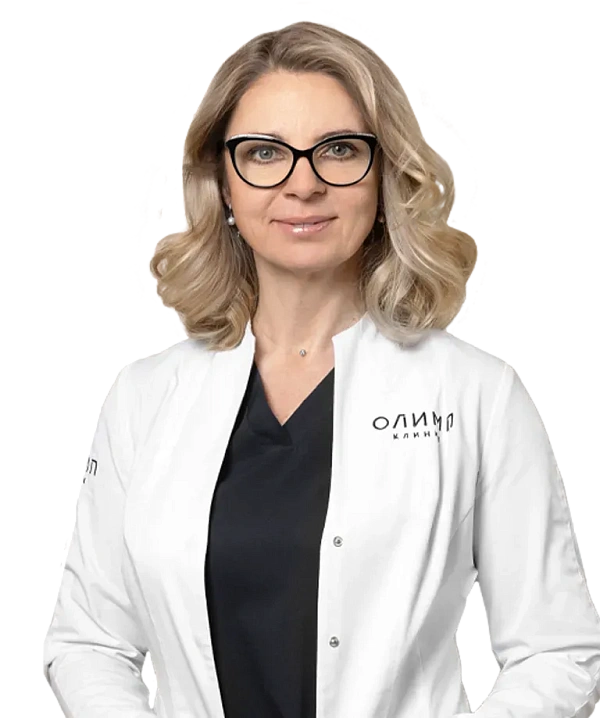
Doctor of the highest category, surgical obstetrician-gynaecologist specialising in anti-age and bioregenerative medicine, oncologist

Gynecologist, endoscopic surgeon. Head of the gynecology department.
Indications and contraindications
Indications
The presence of ovarian cysts
Formations that cause pain, menstrual irregularities, or problems with conception.
Endometrioid cysts (endometriomas)
Endometriosis-related formations that require a special approach to treatment.
Dermoid cysts
Complex benign formations containing various types of tissues.
Serous and mucinous cysts
Large formations that can cause discomfort and dysfunction of nearby organs.

Expected effect
Reduction of symptoms
Reduction of pain and discomfort, normalization of the menstrual cycle.
Restoration of reproductive function
Elimination of the causes that prevent the onset of pregnancy.
Prevention of complications
Preventing the degeneration of benign formations into malignant ones.
Elimination of relapses
Reducing the likelihood of recurrent cysts and benign ovarian diseases.
Similar referral activities
Consultation of a gynecologist
Medical examination aimed at diagnosing, treating and preventing diseases of the female reproductive system.
Removal of tumors in the intimate area
A procedure aimed at eliminating benign growths such as papillomas, warts, cysts and genital warts.
Reproductive surgery
Surgical treatment and simultaneous accurate diagnosis of female infertility factors: adhesions, endometriosis, congenital malformations of the genital organs, obstruction of the fallopian tubes, intrauterine pathology (septum and synechia), polycystic ovary syndrome.
Cervical plastic surgery
Cervical plastic surgery (tracheloplasty) is a surgical restoration of the anatomical structure and function of the cervix, which helps to maintain the health of the reproductive system.
Treatment of vulvar diseases
Vulvar diseases, including chronic fissures, sclerotrophic lichen and other dermatological conditions. We offer modern and effective treatment methods aimed at reducing symptoms and restoring the normal condition of the vulva skin.
Correction of menopause problems
The onset of menopause is often accompanied by a number of physical and mental manifestations unpleasant for a woman. The gynecologist will choose therapy, which can relieve or completely eliminate the symptoms.
How to reach


- Route from the «Sukharevskaya» metro station
- Route from the «Tsvetnoy Boulevard» metro station
From the metro station "Tsvetnoy Bulvar"
1 exit to the city, then left to the Garden Ring, at the crossing to the right, crossing the boulevard, one more crossing and at the traffic light to the left. The Olymp Clinic building is located overlooking the Garden Ring to the right of the crossing. Travel time is approximately 9 minutes. Landmark - sign Olymp Clini
From the metro station "Sukharevskaya"
Exit 3 from the metro and 640 meters straight ahead, the clinic will be on the right. Landmark - sign Olymp Clinic
Parking lot map
Exit 3 from the metro and 640 meters straight ahead, the clinic will be on the right. Landmark - sign Olymp Clinic